Showing posts with label Fort Benton. Show all posts

Friday, February 5, 2021

White Man's Buffalo


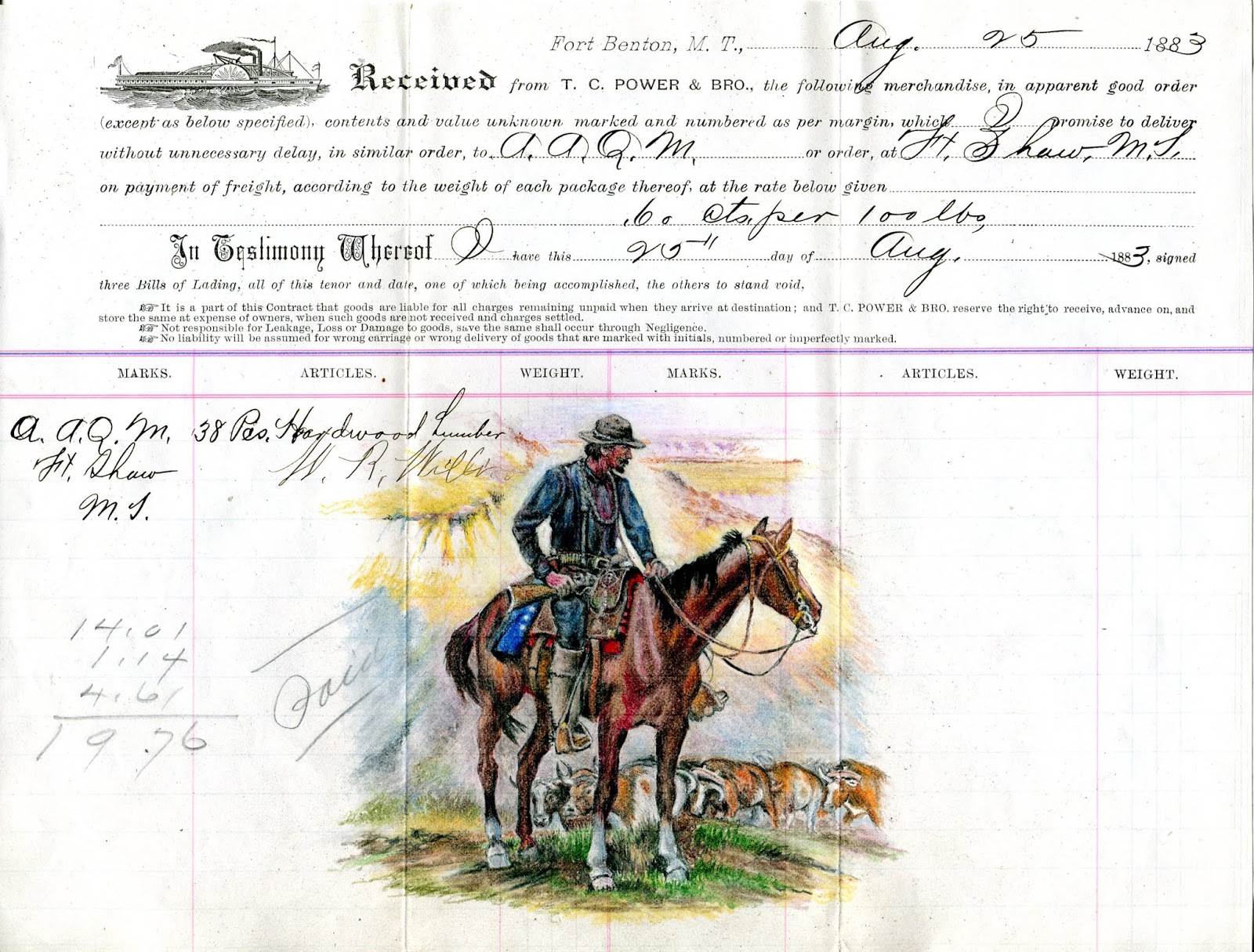
The image is from a C. M. Russell painting executed by him in 1919. The document itself is a bill of lading for a wagon load of goods from T. C. Power & Brother in Fort Benton, Montana Territory, in late May of 1882. I could research which of the boats would have arrived that early from St. Louis, because I have that recorded somewhere. Regardless, the wagon was dispatched to the Indian Trader at Fort Shaw, J. H. McKnight. Included on the wagon was a barrel of whiskey, at least 6 barrels of salt and hardwood lumber. The driver had to sign his name to the document. Partridge. No initial. Mr. Partridge signed, essentially testifying the barrel of whiskey would arrive at Ft. Shaw in the same condition it left Ft. Benton.

The image depicts an escaped young steer from a Bull Team, and the Indians are confused as to the nature of the beast they are looking at. The one on the Left is signing Buffalo...hence the title that Charlie gave to this painting that I've attempted to create in miniature.


Monday, February 18, 2019

James W. Diamond R. Brown


From C. M. Russell's "Wagon Boss"

The possible names that I have and the sources for those names in this image are as follows: The Gilcrease Museum where the original painting resides cites a passage from the book Half Interest in a Silver Dollar: The Saga of Charles E. Conrad. On page 22 "The man in the painting is sitting on his horse as he watches the progress of the wagons up the grade. Art critics believe the man pictured is Ed Trainer, wagon boss for the I. G. Baker Company."

From the CMR Museum Archives: Col #2011.8.3 Box No. Card 6, Frederic G. and Ginger K. Renner Special Collection, Wagon Boss Card No. 2 3429B The Wagon Boss in the painting is"Doc" Freeles of Fort Benton, uncle of Coburn F. Maddox. Originally sold by Nancy Russell to Fletcher Maddox.

The most intriguing name that I found I can attribute to Ken Robison, historian at the Overholser Historical Research Center in Fort Benton. In a two part story for the River Press in 2012, Mr. Robison described a fellow by the name of James W. Brown who was a Civil War veteran, and in part one of the story, his military experiences, including the fact he was wounded three times is outlined. The second part of the story, and the one that I found tells of the most likely subject of the painting, although Charlie could very well have substituted the face of anyone for that of James Brown. The character that was portrayed may have been a combination of gear for the Diamond R, and a subject of Charlie's choice.


James W. Brown came west as a bull whacker in the Summer of 1866, driving a team of oxen and wagon from Nebraska to Salt Lake City. He loaded the wagon with freight for Helena in August, and arrived in Helena in September. Originally working for another business as wagon boss, he engaged with the original Diamond R, owned by John J Roe & Company under the business name Overland Express Company. I'm including an image of a way bill for the Diamond R below.


I've yet to decide what I'm going to put on this one, but it will involve the Diamond R, that's for certain.

Friday, September 14, 2018

Diamond R on Helena Hill


The Original Document


I am going to begin with a description of the original document, and an explanation of its nature. It is called a Bill of Lading, and this type of document is still in use today. It serves the purpose of assigning responsibility for cargo being moved from one place to another. This is the third of three Bills for a Bull Train from Fort Benton, M. T., to Fort Shaw, M. T., on May 17th, 1883. The first two Bills would have documented the itemized contents of nine wagons, three wagons being pulled by sixteen to eighteen bull oxen each. They were designated or named as the Lead, the Swing and the Trail wagons.

This third of the three Bills that made up this manifest is self-explanatory, and the handwriting is easily read.
An easy one to decipher is the #5 Lead, Swing and Trail wagon team, which together accounted for twelve thousand fifteen pounds of goods. In pencil, on the right side near the middle of the document is the amount paid for the eighteen wagons, in three wagon teams. #5 Team would have been paid one hundred twenty-three dollars and fifteen cents for its share.

T. C. Power & Brothers contracted the movement of freight to support the government troops at Fort Shaw, and the Indian Trader, J. H. McKnight at the Fort. This document came originally from the collection of Lewis Brackman of Helena, MT. The story of how he came to acquire it is for another day. Sometime after he acquired it, he sold it to Stuart MacKenzie of Chinook, MT. He graciously sold me this paper from his collection because I've been intrigued with early territorial business paper, and he knew what I intended to do with it.

After spending almost five hours removing Scotch tape from the back (all seams and intersections of seams) both horizontal and vertical were so thin I could see through them. Some paper repair was in order and archival paper repair tape (about two feet) kept it together and allowed me to remove ink, both part of the document (lines and columns) and manuscript where it would interfere with the image.

Who was the Wagon Boss?  

The next part of the story involves the title of the painting, and who this gentleman was, or at least could have been. There are some hints in the picture, including the Diamond R on the canvas sheets of the first two wagons, and the Diamond R on the pouch hanging over the saddle horn. Also, hanging over the back of the saddle there appears to be a military jacket with bright buttons.

The possible names that I have and the sources for those names are as follows: The Gilcrease Museum where the original painting resides cites a passage from the book Half Interest in a Silver Dollar: The Saga of Charles E. Conrad. On page 22 "The man in the painting is sitting on his horse as he watches the progress of the wagons up the grade. Art critics believe the man pictured is Ed Trainer, wagon boss for the I. G. Baker Company."

From the CMR Museum Archives: Col #2011.8.3 Box No. Card 6, Frederic G. and Ginger K. Renner Special Collection, Wagon Boss Card No. 2 3429B The Wagon Boss in the painting is"Doc" Freeles of Fort Benton, uncle of Coburn F. Maddox. Originally sold by Nancy Russell to Fletcher Maddox.

The most intriguing name that I found I can attribute to Ken Robison, historian at the Overholser Historical Research Center in Fort Benton. In a two part story for the River Press in 2012, Mr. Robison described a fellow by the name of James W. Brown who was a Civil War veteran, and in part one of the story, his military experiences, including the fact he was wounded three times is outlined. The second part of the story, and the one that I found tells of the most likely subject of the painting, although Charlie could very well have substituted the face of anyone for that of James Brown. The character that was portrayed may have been a combination of gear for the Diamond R, and a subject of Charlie's choice.

James W. Brown came west as a bull whacker in the Summer of 1866, driving a team of oxen and wagon from Nebraska to Salt Lake City. He loaded the wagon with freight for Helena in August, and arrived in Helena in September. Originally working for another business as wagon boss, he engaged with the original Diamond R, owned by John J Roe & Company under the business name Overland Express Company. I'm including an image of a way bill for the Diamond R below.


In 1868, Charles A. Broadwater, E. G. Maclay, Mathew Carroll and George Steele purchased the Overland Express Company, and James W. "Diamond R" Brown became their Wagon Boss. Sometime in 1870, he ceased working for the Overland Express Company and begin a business venture on shares with a fellow by the name of Kipp. He retired in his later years to ranch near Browning, married a Piegan woman and raised a family with her. He died peacefully in 1927.

I have linked to the rather lengthy article written by Mr. Robison, but I will once again link to it so that the full story can be read. James W. "Diamond R" Brown.


Wednesday, June 20, 2018

The Fireboat Benton

Bill of Lading
for Jas. E. Booge & Co.,
From the collection of Lewis Brackman

The Fireboat Benton,


from C. M. Russell's
Fireboat

From the Sioux City Courier: In 1858, James Booge arrives in Sioux City. After buying a steamboat's water-logged load of wheat, he feeds the grain to a herd of hogs, butchers the animals and sells the meat to local butcher shops and the U. S. Army.

He went on to put into operation one of the largest meat packing plants in the United States at the time. In late April of 1881, Booge ships 20 sacked hams and 5 sides of bacon to J. H. McKnight, the Indian Trader at Fort Shaw, Montana Territory. It was carried by the Benton to Fort Benton, and arrived at Fort Benton on the 30th of May, or the 24th of June. One way or the the other, the pork was delivered.

Russell painted this little gem (16" X 25") in 1918, following more than one trip to New York where he was exposed to the color palettes of several well-known Eastern artists including Maxfield Parrish and Philip Goodwyn. Both of these artists were skilled in using vibrant colors and their compositions were constructed for maximum impact. Russell's fireboat would have done just fine for my version, but since the Indians had seen steamboats on the Missouri at least 30 years before the arrival of the Benton in 1881, I chose to put the Benton on this piece of steamboat history.  
  

Thursday, October 2, 2014

Stolen Cannon and the Battle of the Big Hole.


This is the companion piece to my post of yesterday, and depicted is a Mountain Howitzer, similar to the one taken from Fort Shaw, Montana Territory in 1877 by Colonel John G. Gibbon, to pursue over 750 Nez Perce Indians under Chief Joseph and Looking Glass. The Nez Perce had moved into Montana ostensibly to avoid being placed on a reservation, and their moving village consisted of approximately 90 tipis.

On Aug 9th and 10th of 1877, Colonel Gibbon lost not only 30 officers and enlisted men, but he also lost this cannon for a time. The two hundred pound barrel proved to be too much for the Nez Perce after its capture, so it was soon abandoned.

I've learned from the owner of this document that Mr. Phil Manix was a Civil War Veteran who for a time was the Post Trader at Fort Shaw, just as J. H. McKnight was. Manix moved on to Augusta where he ran a General Store. The building still stands and is still a General Store.  

Friday, February 7, 2014

The Steamboat Dacotah

The Steamboat Dacotah

This is a veritable treasure as history goes. The particulars are as follows: Dated the 16th of June, 1881, Montana would not be a state for another eight years. It is a bill of lading addressed to J. H. McKnight who had the trading post at Fort Shaw, West of what is now Great Falls on the Sun River. It was one of three sister steamboats built specifically to haul freight from St. Louis, Missouri, to Fort Benton, Montana Territory. The three sisters boats were the Montana, the Dacotah and the Wyoming.Of those three boats, the Dacotah hauled the greatest tonnage of freight to Fort Benton, and did that on its second trip of the year in 1881 arriving at Fort Benton on the 4th of July.

The Dacotah was actually the 6th boat to arrive at the levee, and the date indicated on this way bill is not the day that it arrived, but rather the day the freight was unloaded. This boat actually belonged to the Coulson brothers, and was not a boat which belonged to T. C. Powers. My assumption is that some of the freight belonging to Powers was put on the landing at Coal Banks, and was then transported to Fort Benton on the Dacotah, thus explaining the reason why this is a Power way bill rather than a Coulson way bill.

Regardless of who this boat belonged to, this image was taken from the only extant photograph of the Dacotah.