Friday, July 11, 2025

Jurassic Jack


There was a Sand & Gravel and Concrete business in Shelby, Montana, where I grew up. Jim Horner had a business with another fellow on the banks of the Marias River five miles South of Shelby. Jack Horner, who is the subject of this post, grew up with dyslexia, which is also an issue which troubled him immensely.  The dyslexia was a source of Jack's reading issues, but making the most of his early childhood, was a matter of just barely making it through school. 

Although barely graduating from High School, he was drafted into the Marines, and served in Vietnam as a Special Forces Recon. The sand and gravel business led Jack to be inquisative about rocks in general, and fossils especially. After living in a tent on the river, Jack's parents moved into a nice brick home in Shelby, on the side of a hill overlooking town. Later, he and his brother would take over the sand and gravel business. While building rockets, which he launched at the airport, he also managed to blowout the basement windows in the brick family home. 

He never did obtain a PHD, but he did know where to look for fossils, including the hill across from his home on the hill overlooking Shelby. He helped anybody interested in fossils, mostly because he knew where and what to look for. I was one of those interested, and rocks and fossils went well together.

This piece of letterhead predates Jack's association with the museum. I thought it was appropriate to use it for this artwork!


Tuesday, June 7, 2022

Last of His Race


The cultural clash between the noble Indian with his pipe and empty tobacco pouch, and the lack of a feather on his head, yet the well dressed lady riding the bicycle has one in her hat. I think there are plenty of clues as to why this is so stark and telling of Charlie's story in pen and ink.  


The Toll Collector


 From 'Names on the Face of Montana', by Roberta Carkeek Cheney: "About three miles below the junction of the Sweetwater and Ruby River where several natural hot springs were found, and on the direct wagon train route of pioneers coming from the south toward Virginia City."

Mr. Puller was the Postmaster, as well as building a saloon, a dance hall and hotel. Mr. Chas. Metzel later purchased the properties from Mr. Puller, and raised horses and cattle. 

The image is from nowhere near Virginia City, but rather in the breaks of the Missouri. 

Friday, March 11, 2022

Robe Trader


from Russell's "Joe Kipp's Trading Post"

Charlie did three paintings of Joe Kipp's Trading Post, two exterior and this interior. Nine figures included, and I believe the woman who had a 'hand' in dressing these robes is a quiet observer. I hope I find more paper like this to let me continue telling the stories.


Friday, February 5, 2021

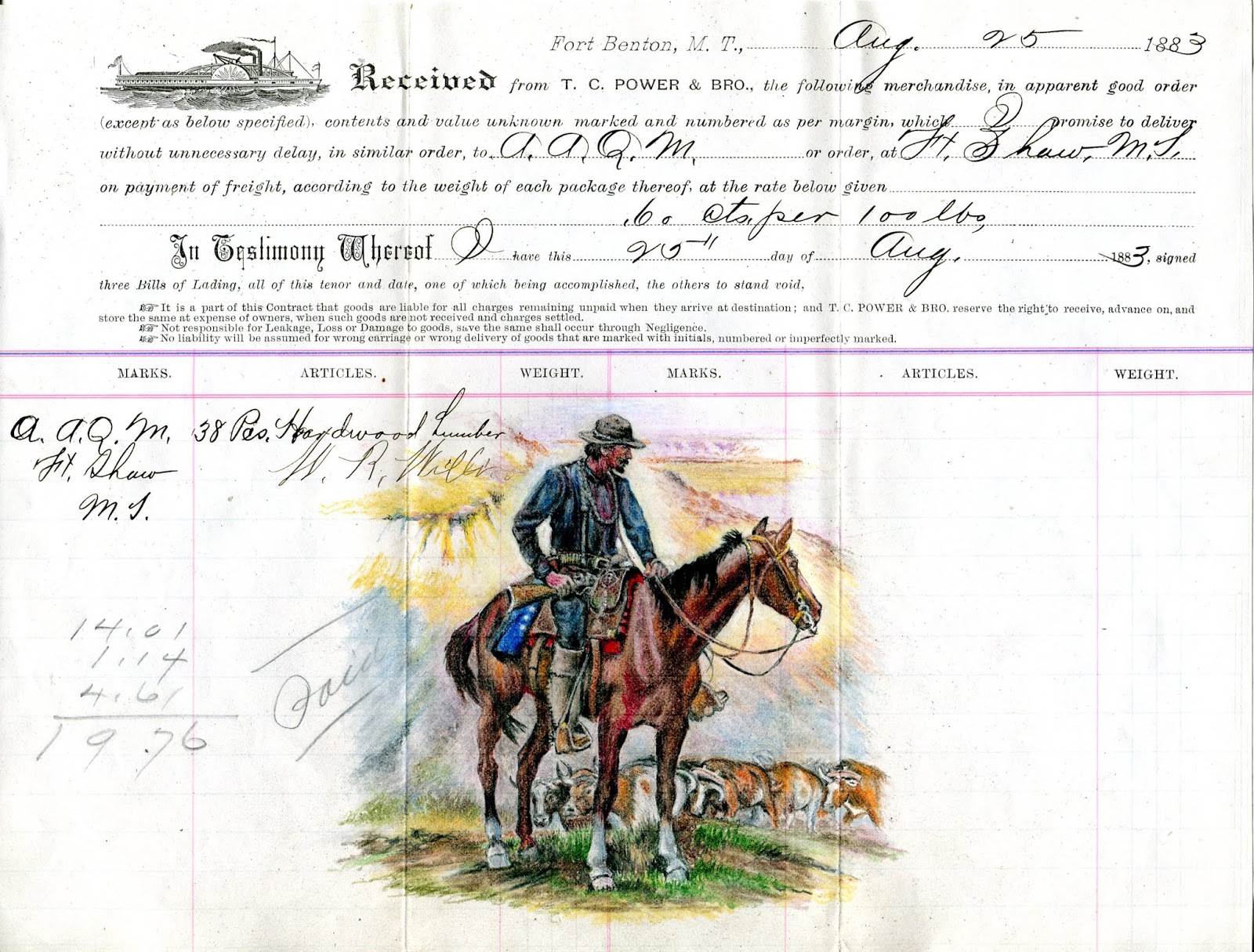
White Man's Buffalo


The image is from a C. M. Russell painting executed by him in 1919. The document itself is a bill of lading for a wagon load of goods from T. C. Power & Brother in Fort Benton, Montana Territory, in late May of 1882. I could research which of the boats would have arrived that early from St. Louis, because I have that recorded somewhere. Regardless, the wagon was dispatched to the Indian Trader at Fort Shaw, J. H. McKnight. Included on the wagon was a barrel of whiskey, at least 6 barrels of salt and hardwood lumber. The driver had to sign his name to the document. Partridge. No initial. Mr. Partridge signed, essentially testifying the barrel of whiskey would arrive at Ft. Shaw in the same condition it left Ft. Benton.

The image depicts an escaped young steer from a Bull Team, and the Indians are confused as to the nature of the beast they are looking at. The one on the Left is signing Buffalo...hence the title that Charlie gave to this painting that I've attempted to create in miniature.


Breakfast Brownie Doughboy


Pillsbury has their doughboy, so I think Breakfast Brownies Cereal can have theirs too!

There is little known about the Breakfast Brownies Company, and not a whole lot more about the Brownie Baking Company, except that they were not one and the same. The Breakfast Brownies Company was incorporated in 1919 in Montana, and although the officers were not all in or from Helena, the cereal was milled in Minneapolis and packaged here in Helena. Just exactly where in Helena I cannot determine, although I do know where their office was located.

I have seen a cardboard case for the cereal, a stock certificate, as well as one sample box and a dozen metal plates for print advertising. One of the plate images is the source for my Brownie Doughboy.

I acquired several pieces of letterhead for the Brownie Baking Company, whose bakery was in Spokane, Washington. I do know that the Brownie Baking Company was once the Tru-Blu Biscuit Company, because I have seen five real photo postcards of the factory, and the message side of the card has the Tru Blu logo printed on it. Research on the web reveals very little about the company, other than the fact the factory bakery building is still in use – not as a bakery, but it's now artist studio space.

I decided to put the Breakfast Brownies Doughboy on this piece of Brownie Baking Company letterhead because they had one thing in common – they both used the images of Brownies to sell their products. Note the Brownie in the lower left corner of their letterhead. I've never done this sort of thing before, but my chances of ever finding a piece of Breakfast Brownies paper are slim and next to none.

Well? Do you think this piece of advertising art would fly up against the Cocoa Puffs of the cereal world?


Saturday, February 8, 2020

Harley Board Track Racer, Too


Harley-Davidson board track racer on a piece of Harley-Davidson Motorcycle paper. Mr. Monte Chadbourne finally settled in Livingston, Montana, and the paper came to me from my brother-in-law, who restores Indian Motocycles. He purchased at least one Indian basket case, and apparently a box of paper. It's headed to my framer, and then on the Western Art Week in Great Falls the third week of March. 

Thursday, January 16, 2020

Walkin' the Talk, and Talkin' the Walk.


The Parrot Talks for Itself, and the Poll-Parrot shoes Speak for Themselves, so it's all good!


Double Golden Gleam Nasturtiums


I started with an American Beauty Rose, moved on to Gladiolus, tackled Geraniums, and now I've done some Nasturtiums. Image was from a vintage Sioux City Seed Company packet.


Piggly Wiggly, Part One.


The first page of a two page letter from a son working for Piggly Wiggly in Denver, to his father in Glasgow. Recognizable image from predominantly a Southern market, although I believe there was a Piggly Wiggly in Northeast Montana at one point.

Thursday, December 5, 2019

Bronco Buckingham


Bronco Buckingham

Without the invention of the refrigerated railroad car, we wouldn't have - wait for it - Bacon! A fellow by the name of Gustavus Swift promoted the refrigerated rail car to sell his meat and get it shipped safely. The Buckingham brand I copied from a California fruit label - pears, specifically. And yes, there were refrigerated rail cars in 1894.


Wednesday, November 6, 2019

Rocky III


This is the second of two pieces of Glacier Park Hotel Company letterhead on which I've used this composition. There are a couple of Rocky posts that I've included, and more than one way to find them out here. Check labels in the right hand column.

Saturday, October 5, 2019

Cowboy Watering Geraniums


Untitled advertising image by Philip R. Goodwin
for UMC-Remington

From wikipedia, Keen Kutter is a trade name first used by Simmons Hardware Company of St. Louis, Missouri in 1866. The name was adopted as a trademark by Simmons Hardware Company in 1870 and was used on their highest quality tools and cutlery.

I have five or six pieces of Simmons Keen Kutter billhead such as this one, and I like using the itemized list as a foil for the art I put on it. I am a big fan of the advertising artists of the late 1800s and into the turn of the Century. 

This is just one example of the use of a certain brand (UMC/Remington), only for the image to be sold to another  brand (Peters) and the product was replaced by Goodwin.


Friday, September 13, 2019

Treasure Box

When Guns Were the Locks on the Treasure Box

Way Bill No. 195 for August 14, 1897, the Virginia City & Red Bluff Stage Company. I've added my version of C. M. Russell's "When Guns Were the Locks on the Treasure Box". I've added a short barreled 12 gauge shotgun and a Sharps rifle. I don't know that many kids these days would know where the term "riding shotgun" came from, except riding beside the driver in the passenger seat.
The original is a water color painted on tan paper. Just another example of Charlie's finest.

Wednesday, August 14, 2019

F. J. Nye Saddle


This piece of billhead was brought to me during Western Art Week this past March. The gentleman wanted me to put a saddle on it, and included another billhead with a vignette of a tooled saddle. I went one better, bought a book from the Montana Historical Society Bookstore entitled: "Saddleries of Montana". In the book on pages 183 and 184 are depicted several black and white engraved images put up as ads for Mr. Nye, and another Helena saddler by the name of Ben Roberts. A little bit of a backstory here: Ben Roberts housekeeper was a young lady by the name of  Nancy Cooper. Nancy would marry my favorite artist, C. M. Russell. A tooled saddle. I'd do another, and will perhaps find some other saddlery paper from the early saddlers.

Friday, May 17, 2019

Territorial Brand Certificate


A document which was brought to me at the Footprints on the Trail show in Great Falls during Western Art Week.  They asked for Charlie's image of a starving cow by itself, and no brand, since the certificate had the brand specified on the Left. I wish I could find a Territorial Brand Certificate actually utilized before 1889.

Sunday, April 28, 2019

Harley-Davidson Board Track Racer


Harley-Davidson board track racer on a piece of Indian Motocycle paper. Because I wanted to. It's in its new home. There will be more. I have some Harley-Davidson paper. Perhaps I'll put an Indian board track racer on it. Keep things even so to speak.

Monday, February 18, 2019

James W. Diamond R. Brown


From C. M. Russell's "Wagon Boss"

The possible names that I have and the sources for those names in this image are as follows: The Gilcrease Museum where the original painting resides cites a passage from the book Half Interest in a Silver Dollar: The Saga of Charles E. Conrad. On page 22 "The man in the painting is sitting on his horse as he watches the progress of the wagons up the grade. Art critics believe the man pictured is Ed Trainer, wagon boss for the I. G. Baker Company."

From the CMR Museum Archives: Col #2011.8.3 Box No. Card 6, Frederic G. and Ginger K. Renner Special Collection, Wagon Boss Card No. 2 3429B The Wagon Boss in the painting is"Doc" Freeles of Fort Benton, uncle of Coburn F. Maddox. Originally sold by Nancy Russell to Fletcher Maddox.

The most intriguing name that I found I can attribute to Ken Robison, historian at the Overholser Historical Research Center in Fort Benton. In a two part story for the River Press in 2012, Mr. Robison described a fellow by the name of James W. Brown who was a Civil War veteran, and in part one of the story, his military experiences, including the fact he was wounded three times is outlined. The second part of the story, and the one that I found tells of the most likely subject of the painting, although Charlie could very well have substituted the face of anyone for that of James Brown. The character that was portrayed may have been a combination of gear for the Diamond R, and a subject of Charlie's choice.


James W. Brown came west as a bull whacker in the Summer of 1866, driving a team of oxen and wagon from Nebraska to Salt Lake City. He loaded the wagon with freight for Helena in August, and arrived in Helena in September. Originally working for another business as wagon boss, he engaged with the original Diamond R, owned by John J Roe & Company under the business name Overland Express Company. I'm including an image of a way bill for the Diamond R below.


I've yet to decide what I'm going to put on this one, but it will involve the Diamond R, that's for certain.

Saturday, February 16, 2019

A Quiet Day in Utica


"A Quiet Day in Utica"
first titled "Tinning the Dog"

A fabulous piece of history here, which includes a number of recognizable individuals. The most important fellow is head and shoulders above the rest, and the gentleman whose sons commissioned Charlie to paint this piece for their father, Charles Lehman, or as Charlie called him "Charley". His name is on the sign above his business. A total of fourteen individuals are depicted, including Charlie himself, leaning against the rail just to the right of the Tinned Man's ride. Also, three chickens untold horses and one unhappy dog. The large tin, if anyone is curious, was for fish oil.

Tuesday, January 22, 2019

Sharps 1874 Big .50 Sporting Rifle


I will start with the subject of this piece first. I found this rifle on an auction site with plenty of close-up photographs and provenance. The site is Collectors Firearms, The serial number is pictured in one of the photographs as #C54634, one of three Model 1874 Sporting Rifles in .50 Caliber shipped from the factory in Hartford, Connecticut. The shipping date is listed as April 24, 1875, and was sent to a the sporting goods dealer Spies, Kissam & Company in New York City. The total cost of all three of these rifles, plus bullet molds and shipping crate was $92.94.

I could have chosen a different Sharps, perhaps one of their Buffalo Rifles, but Collectors Firearms supplied plenty of photographs of this one, and I decided to go with this one rather than one that perhaps would have been used here in Montana - because I LIKED IT.

I have used this rifle before.  In 2016, I used it on a piece of billhead for another early Helena merchant, although this time I'm even more confident that I've used a document that has been authenticated. A Montana gentleman who collects anything Sharps has confirmed that Adolph Birkenfeld was indeed a Sharps dealer, and one of the rifles he owns is listed as being shipped to Mr. Birkenfeld in 1874. The business was at 10 South Main, and the business was still at the same location in 1900. The census for that year lists Mr. Birkenfeld as a Capitalist. He was in the right business!